Tuesday, July 27, 2010

Day 2: JPOST reporter Mandel sheds light on Emmanuel affair


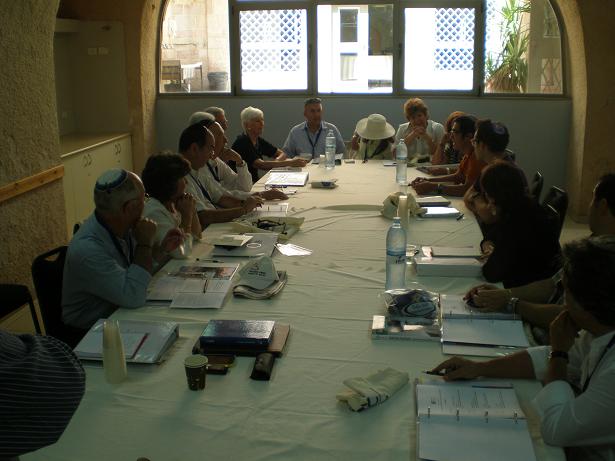
After hearing from a series of scholars and rabbis last night and today, this afternoon the Jerusalem Post’s religious affairs reporter, Jonah Mandel, spent time with us to give new insights into the everyday life of Sephardim and especially religious Sephardim living in Israel.

Mandel shed light on the contentious Emmanuel affair that has been unfolding during the last three years. The case involves religious Sephardic Jewish children from the “Slonim” sect in the small and poor Israeli city of Emmanuel who were allegedly victims of racial discrimination by religious Ashkenazi faculty members of their “Bet Yacov” school. As a result, the parents of these children sued the State of Israel for racial discrimination since the government fully funds the school and did not take measures to prevent the discrimination. Ultimately the Israeli Supreme Court ruled in favor of the parents and ordered an end to the discrimination, but the case had other “interesting” twists and turns that I won’t get into but can be read in Mandel’s recent piece in the Jerusalem Post.

After his discussion with us, I sat down with Mandel for this brief interview where he sheds light on the status of religious Sephardic Jews living in Israel…


-- Karmel Melamed

Day 2: Landes reveals the real Rabbi Haim David Halevy


This morning Rabbi Daniel Landes, a professor at the Jerusalem-based Pardes Institute of Jewish Studies joined our group at the S.E.C. to discuss the work of the late Sephardic Rabbi Haim David Halevy. Landes explained that what set Rabbi Halevy aside from other rabbis of his time was the fact that Halevy used modernity and Torah to bring people back to Judaism.

Rabbi Haim David Halevy was the Sephardic Chief Rabbi of Tel Aviv from 1972 until his death in 1998. He was a prominent halakhist, prolific author and a creative thinker. Landes said that a large part of Rabbi Halevy's message to Jews during his life was that "individuals need to assu e responsibilities for themselves in the modern era". Landes said that Halevy's mentor, Sephardi chief rabbi of the British Mandate of Palestine, Rabbi Benzion Uziel, helped him provide creative solutions to modern questions of halacha which was in the long standing Judeo-Spanish Sephardic tradition.

The following is video footage I captured of Landes discussing Rabbi Halvey's approach to "Da'at Torah"...


Here are some snapshots from Landes visit I captured...


(Rabbi Daniel Landes)


-- Karmel Melamed

Photo Essay: Sights from outside the S.E.C.

The area surrounding the S.E.C. here in the Old City of Jerusalem is a remarkable place where east meets west and where the ancient world meets the modern world. I am always blown away at how both worlds can coexist in one place. Earlier this morning I ventured outside the immediate S.E.C.'s building to further explore this area. No where else on planet earth will you such a lovely mixture of the old and new worlds of human kind woven together so beautifully in one area. This is one reason why Jerusalem is so special for the world's three major religions. These sights were remarkable considering the busy traffic in the area, the magnificent views of the various homes in the distances, the ancient stone buildings and an overall magical sense of electricity in the area.

Below are just a few snapshots I captured of the immediate areas surrounding the S.E.C. which are indeed unique and breathtaking.


-- Karmel Melamed


Monday, July 26, 2010

Video Webcasts: Dr. Nessim and Rabbi Bouskila making waves at S.E.C.


Dr. Jose Nessim, a founder of the S.E.C. is perhaps one of the very few people in this world who I consider my hero. This because even though he was successful in his medical profession, he took on the more important and unique challenge of founding an organization dedicated to keeping traditional Sephardic Judaism alive. His vision for such group and center was a task never undertaken by other Sephardim in modern times. It was a long and often tough road for Dr. Nessim, but today after more than 30 years, since his dream has become a lovely reality. The S.E.C.’s center in Jerusalem with offices in North America, South America and elsewhere have become one of the leading, if not the most well known Sephardic organization through out the world. Dr. Nessim had a dream and never gave up on it…and today, Sephardic Jews benefit from that remarkable vision.

Tonight I capture this brief but very touching footage of Dr. Nessim talking about his vision for the S.E.C. becoming a reality….


This is also footage I captured of Rabbi Bouskila discussing the S.E.C.’s objectives in going online to share more details about this week’s summer seminar on Sephardic Judaism for the 21st century on the web through blogging…


-- Karmel Melamed

A Warm Welcome and Insights into Sephardic Rabbis’ Responsa


(S.E.C.’s founders Ron Nessim and Dr. Jose Nessim address those in attendance)


Tonight, nearly two dozen participants of the S.E.C.’s seminar this week in the Old City of Jerusalem were given a warm welcome by the organization’s faculty and founders at an opening dinner. Delicious food and incredible conversation were plentiful inside the dinning hall before the evening’s lecture began. The S.E.C.’s chairman Ron Nessim and S.E.C. founder Dr. Jose Nessim shared some insights about the organization’s objectives to of enhancing Sephardic Judaism through a traditional centrist direction.

Rabbi Bouskila, who organized the week long seminar in Jerusalem, introduced the evening’s keynote speaker, Dr. Zvi Zohar who is a Bar Ilan University professor and leading expert on Sephardic Jewish tradition. Zohar, who surprisingly is not Sephardic, has spent his career researching and writing about the analysis of “halacha” or traditions of Sephardic rabbis during the last 150 years. He has reviewed the writings or “responsa” these various famous rabbis have had to questions posed to them by rabbis in other cities and countries. What delighted those in attendance for the lecture was the fact that Zohar presented a wide range of information from different Sephardic rabbis who were grappling with the problems of interrupting ancient Jewish traditions and laws to fit modern problems Jews in their communities faced. For example, he pointed to early 20th century Rabbi Ya’akov Mizrahi of Buenos Aires, who wrote in one of his responsa regarding women’s studying of Torah. Professor Zohar said that a time when Jewish women were not permitted to study Torah or it was not the norm for them to do so, Mizrahi states that women should be permitted to study Torah in order to keep Judaism alive when raising their children.

I witnessed something very unique for the first time, the seminar’s participants had a lively debate on how one must adapt Sephardic Jewish traditions for the modern age without loosing its key points of importance. It was nice for a change seeing average Jews discussing an essential topic without getting too loud and out of hand! Another important point Zohar made during his lecture was that “the more you know about Jewish traditions (halacha) the more wealth of information to offer those with problems other options in dealing with questions about tradition”.

On an interesting note, I had the pleasure of sitting with Professor Zohar before his meal and he shed light on the fact that his interest in Sephardic Judaism began at a young age. He said after his older eastern European teachers in school referred to Sephardic Jews as “lazy” for not being committed to strictly keeping Judaism or remaining strongly secular, he was curious to find out why Jews who were originally from Islamic or North African countries were able to maintain a happy medium between strict religiosity and strict secularism. To his surprise he discovered that Sephardic religious leaders have always managed to find a happy medium for religiosity without forfeiting their long standing traditions.

-- Karmel Melamed


Here are just some of the photos I captured this evening...


(Dr. Zvi Zohar, Bar Ilan University professor and leading expert on Sephardic Jewish tradition and religious commentaries).


(Rabbi Daniel Bouskila, S.E.C. Director of Special Projects)


(Larry Azose, S.E.C.'s World Executive Director)